
I have currently been working on some D-class vehicle illustrations for a manual that will inform drivers of generic information about these types of vehicles. Beginning with the basics, I have created orthographics of all sides of the vehicles. An orthographic depicts the an object from a straight-on view, usually producing top view, side views and end views.
The following vector illustrations are of a cab-over style vehicle. Quite literally, the cab where the driver and passengers sit is over the hood which holds the engine.
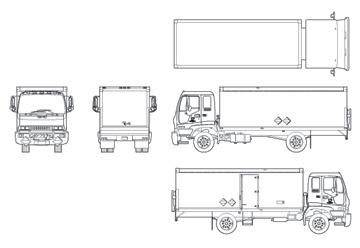
Upon completion of all orthographic views, an isometric projection is completed. All angles in this type of illustration are based on a 30 degree angle. Parallel projection is used to fill in lines to create a 3D image.
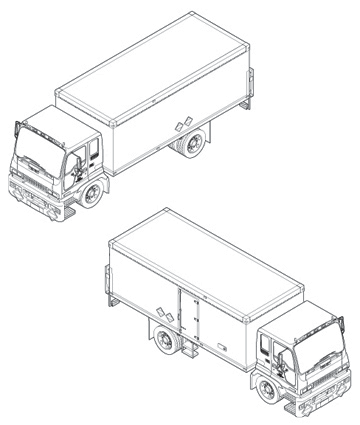
The main benefit to isometric illustrations is in its simplicity, as well as the advantage of viewing an item entirely as an equal. For example, if you were to take an illustration of a room and that room is drawn in perspective, the corner furthest away from the viewer will appear smaller. However, if an isometric view is utilized, all corners will be the same size and therefore there will not be on aspect that appears more important than another.
In many ways, orthographic and isometric illustration takes one back to the basics of technical illustrating.
 Leanne Kroll - Technical Illustration & Design Studio