
Working with National Geographic School Publishing, I recently completed technical illustrations showcasing a concept called the TransHab which was pursued by NASA.
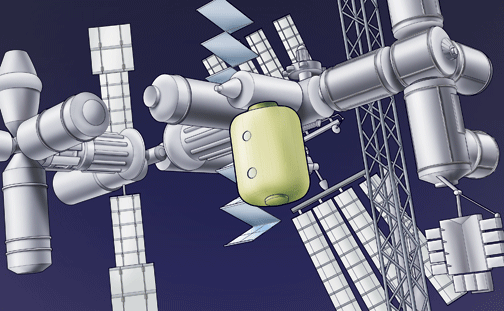
The TransHab was designed as an inflatable living quarters for the astronauts on the International Space Station. The concept allowed the deflated TransHab to be transported up to the Space Station and then inflated and attached upon arrival. The above illustration indicates where the TransHab would be located on the International Space Station.
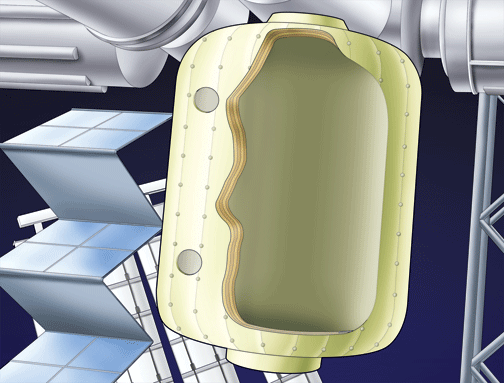
This zoom-in illustration shows the multiple layers of different materials that make up the exterior of the TransHab. These include an external thermal blanket, MOD shielding, a Kevlar restraint layer, redundant bladders and an internal scuff barrier.
The TransHab concept was designed to have four different levels, as shown in the phantom/cutaway view below.
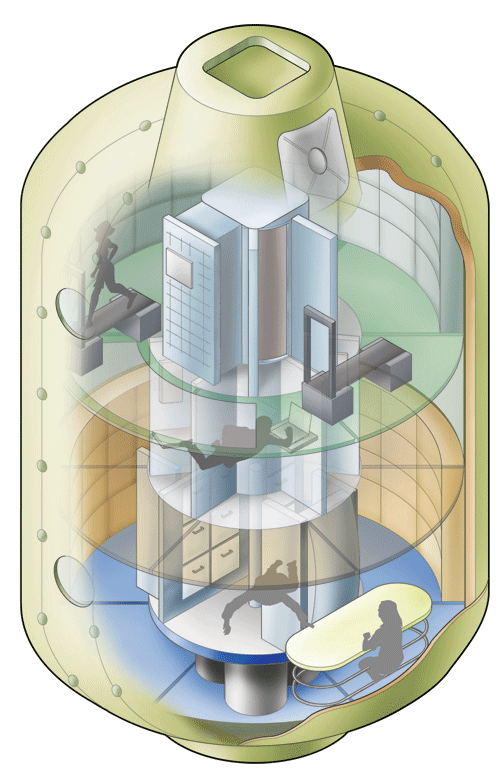
The first level (at bottom) has a kitchen and eating area with galley racks and stowage. The second level contains the crew quarters and a mechanical room. The third level has an exercise area, crew health care area and stowage space. It is the fourth level that is the passageway between the TransHab and the rest of the International Space Station.
In the end, the TransHab concept did not become a reality as development was ceased in 2000. Since that time, similar concepts such as Genesis I, Genesis II and BA 330 have been produced.
 Leanne Kroll - Technical Illustration & Design Studio